

This article may not be reproduced in any form, print or digital, without express written permission from the author, Mary Pat Whaley, copyright 2004, 2026. This article first appeared in 2004 in the North Carolina Button Bulletin.
by Mary Pat Whaley
I found my first acrylic studio button several years ago while buttoning on eBay. I came across a gorgeous Lucite button with a velvety dark background and carvings of planets by artist David Lechleitner. I immediately phoned my mother who was preparing a competition tray of “Heavenly Bodies” for the North Carolina state show. We collaborated and won the button for her tray! When it arrived, it was even more beautiful than the picture. Although I didn’t see many more buttons that year by him, I still looked every so often.
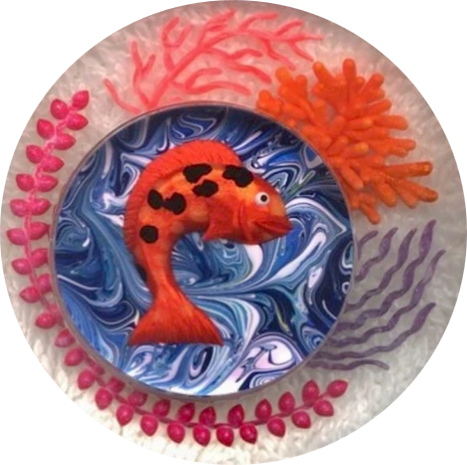
We’re very fortunate to have pictures of David’s acrylic buttons and creations, and a description of his evolution as an artist in his own words.
One of my great joys has been seeing new button artists emerge on eBay and having the opportunity to form my own opinion about the buttons before the rest of the button-collecting world chimes in!
Therefore, imagine my excitement when I started seeing buttons by acrylic artist David Lechleitner appear on eBay again. I bought a number of his buttons and started a correspondence with David, who is from Lake Worth, Florida. Here, in David’s words, is his story.
“I started carving about fourteen years ago. When I was 25 years old, I owned a fishing sinker company. We made fishing sinkers and lead lures. As environmental concerns about lead became more known, I decided to close the company and look for something else to do, however, I still had a warehouse full of the tools used to make the lead products. I met a man who worked for a trophy company that used Lucite in the production of awards and trophies. Since my warehouse was full of tools we decided to try a partnership, and started working with Lucite, mostly making fish tanks and small articles of furniture, tables, and things. The partnership lasted about four months before I realized he was more interested in going out and having fun than working and paying the bills, so I dissolved the partnership.
“I found several books on the carving of Lucite and Bakelite, mostly from the fifties. I started to teach myself how to carve. After a year of learning I had many finished pieces—mostly larger pieces 8” by 8” or bigger. I started to sell my work at art shows and flea markets. Through the shows I got a lot of custom orders: plaques of a special pet, wall hangings of a special vacation and the like. Working art shows is hard work and long hours and being away from home for long weekends, so I started doing consignments instead. After getting burned a few times, I looked for other ways to sell and sold my work on eBay in May of 1998.
“I started carving buttons after I found a book titled “The Bakelite Jewelry Book” copyright 1988 by Cross River Press, Ltd. and written by Corinne Alster Davidov and Ginny Redington Dawes. Once I saw the incredible artwork that was produced by the early artisans of plastic, I was hooked.
‘Working with plastic (Lucite) is much the saWe’re very fortunate to have pictures of David’s acrylic buttons and creations, and a description of his evolution as an artist in his own words.
One of my great joys has been seeing new button artists emerge on eBay and having the opportunity to form my own opinion about the buttons before the rest of the button-collecting world chimes in!
Therefore, imagine my excitement when I started seeing buttons by acrylic artist David Lechleitner appear on eBay again. I bought a number of his buttons and started a correspondence with David, who is from Lake Worth, Florida. Here, in David’s words, is his story.me as working with wood and requires, for the most part, the same tools. There are two types of Lucite, extruded and cast. Cast Lucite is preferred because it carves and polishes easily. Extruded Lucite tends to burn even when cutting with a simple saw. A simple shape such as a fish can be cut out on a band saw, sanded with larger grit sandpaper, working down to an extra-fine grit, then polished on a cloth-wheeled buffing machine.
“Detailed carvings are cut into the back of the Lucite with exactly the same type of tools a dentist would use—the best bits for carving Lucite come from dental supply stores. The hardest part about learning to carve Lucite is learning how each bit cuts. I have well over a thousand bits, and each one makes its own distinct cut and shape in the Lucite. Painting the carving is a little trickier; most paints do not adhere well to the smooth surface of Lucite. Most artists mix their own paints with pigments and some kind of solvent such as acetone, which actually melts the very top layer of Lucite where the paint is applied without hurting the Lucite, making a very strong bond between the paint and the Lucite.
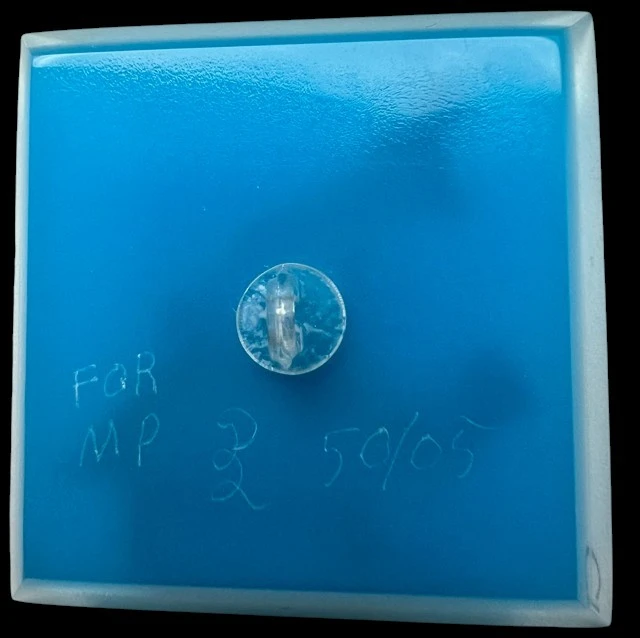
“Gluing Lucite or applying a Lucite back or shank is done with a solvent. The solvent actually melts the Lucite where it comes in contact with it. The two pieces of Lucite are held or clamped together, the solvent evaporates, and the two pieces of Lucite are fused.
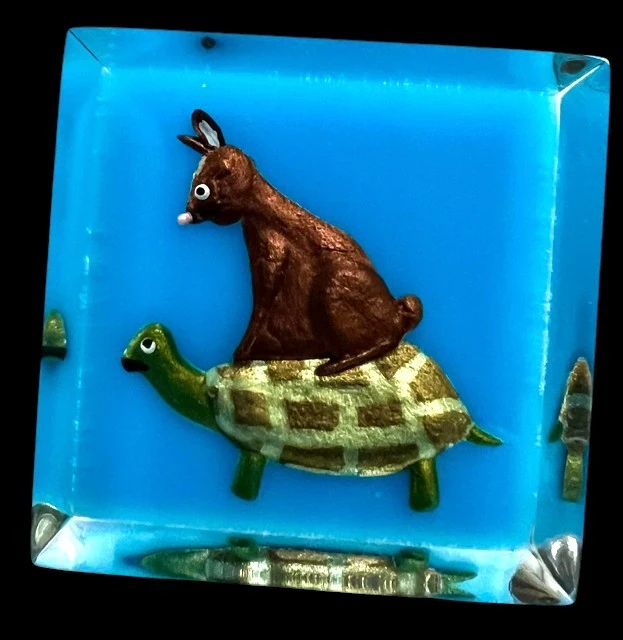
“Most of the subjects I chose came from living in Florida and being an ardent diver. I have traveled to most of the Caribbean and have been on some incredible dives, getting to see close up the beautiful marine life. I also keep a large scrapbook of ideas and pictures I like. Whenever I get blocked, I refer to this book and can always find an idea to work on.
“I admire many great artists, but my two favorites are: Claude Monet (1840-1926) and Constantin Brancusi (1876-1957). Monet would paint the same scene over a period of time, capturing the true vision of how the object looked at the exact moment in time through his use of color. Brancusi was a sculptor who used clean flowing lines and a lack of detail to portray feeling and emotion the way no artist has ever done.
“I have never been to a button show, but I do hope one comes into my area soon. I have not done any commission work for my buttons but have done special requests. I would be interested in doing commission work on my larger carvings if someone wants to put a whole scene (like an exact copy of New York City!) onto a very small carving. When working with such a small object, size and scale really matter.
“As for my artwork and my future, I will always be creating art. I am starting to work with the casting of metals such as silver and pewter and am working on combining those materials with Lucite. I have recently started acquiring the tools needed to sculpt marble and stone and look forward to working with those materials as well.
“My favorite quote from an artist is: ‘Everybody discusses (my art) and pretends to understand… When it is simply necessary to love… ‘ Claude Monet.“
This article was originally written by Mary Pat Whaley in 2004 for the North Carolina Button Bulletin.
