

This article may not be reproduced in any form, print or digital, without express written permission from the author, Deborah Allnutt. Copyright 2026.
by Deborah Allnutt 2026
God, in his wisdom, made the Fly.
And then forgot to tell us why.
Ogden Nash
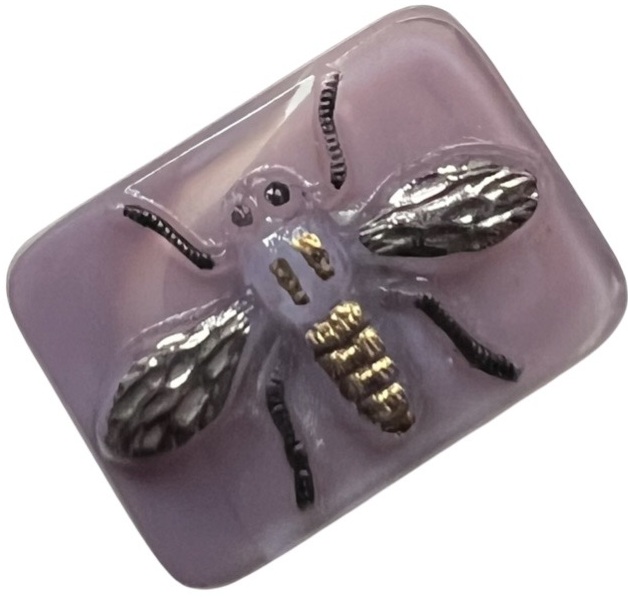
They are annoying. We swat them away from our face with our hands. We aim for the one crawling on the counter or the mirror with a rolled-up magazine or a swatter – and we miss. We cover our food to keep away these disease carriers. THEY are flies, and THEY are everywhere.
There are approximately one million species of flies between the two subclasses of the order Diptera making them the fourth largest insect group in that order. Only around 125,000 have been formerly described, the rest await further contemplation. Found on every continent on earth except Antarctica, 18,000 species of flies are found in North America alone. The earliest fossils of this insect were found to be from the Triassic period, which was about 240 million years ago. They are resilient.
Flies are the only major group of insects to have a single pair of wings. Once upon a time they had four wings, but two devolved into two tiny structures called halteres. The halteres vibrate vertically at the same speed as the other two wings and act as rudders to keep the fly balanced in flight. The most common flies are house flies and mosquitoes. Gnats, blow flies, horse flies, and black flies have also evolved from being four winged insects. Butterflies and dragonflies have four wings and therefore are not considered to be a true fly. An adult fly generally lives 21 days. A female house fly can lay up to 600 eggs in her short time on earth. There may be as many as ten or more generations of house flies in a season.
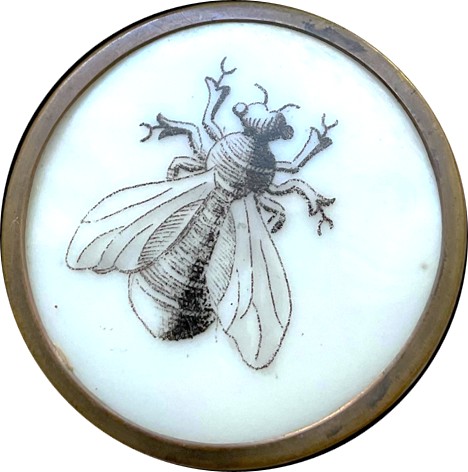
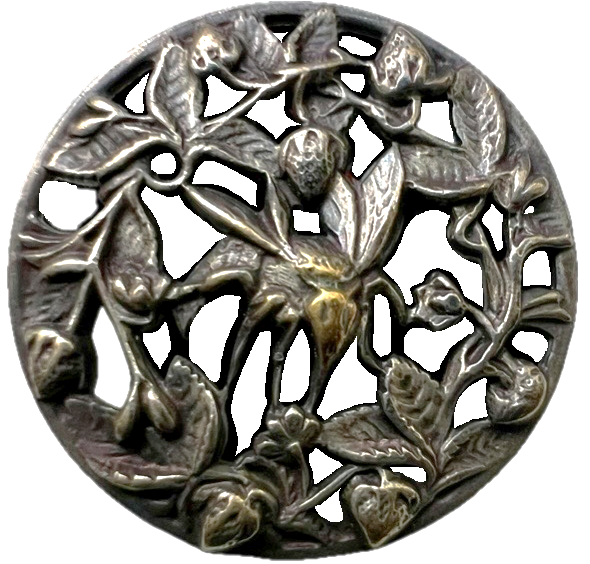
Each foot of a fly’s six legs has a pair of claws that resemble tongs which hold on to rough surfaces. Beneath the claw is a sticky pad which the fly uses to hold on to smooth surfaces. It is this pad that allows a fly to walk up walls, mirrors, the sides of cabinets, and across ceilings. These feet, plus all the little hairs on his body, are what carry disease. If a fly lands on a heap of garbage, for example, he transfers whatever particles he’s picked up there to that slice of watermelon you’re eating. However, a fly that lands on your food for only a second or two is probably not there long enough to transfer enough bacteria to do harm. A fly tastes with his feet so he’s probably enjoying that watermelon as much as you are.
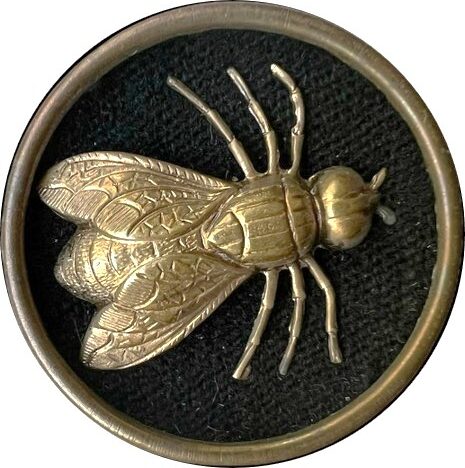
Many of our fly buttons were worn on garments during the Victorian Age. The Victorians were fascinated by insects because they bear no resemblance to humans at all. Victorian entomologists weren’t highly regarded by their peers, but when the relationship between mosquitoes and disease finally was understood, they gained respect and were called upon to help control the insects and stop diseases like diarrhea and typhoid. Victorian author Sir Conan Arthur Doyle made the villain in his The Hound of the Baskervilles an entomologist. When he retired, Doyle took up beekeeping.
Flies have often been a subject in literature. In the 1954 book, The Lord of the Flies, by William Golding, a popular choice of teens, the flies are a symbol of children stranded on an island without any adults.
Want to keep flies from landing on you? Trying wearing clothes with stripes. Researchers in the UK and the USA have found that flies land less frequently on zebras, and on horses that were wearing a coat of zebra-like fabric. Their reasoning is that the lines disrupt the fly’s ability to make a controlled landing.
So why do we miss when we swat at a fly more often than we hit it? It’s not because he’s super-fast, because he isn’t. His top speed is about five miles per hour and he’s not capable of sustaining that speed for long periods. The answer is because a fly sees the world in slow motion and can react quickly to what he sees. In the time it takes a human to raise a swatter, take aim, and swing, a fly has already honed in on the swatter and planned his escape route. You swing, you miss, and he flies away only to return to annoy you later.
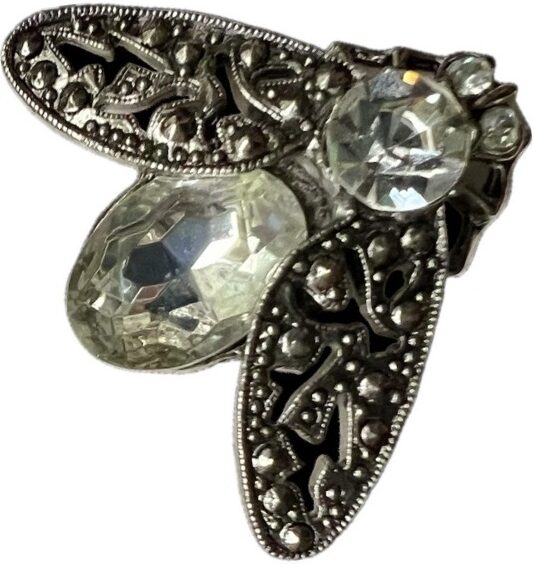
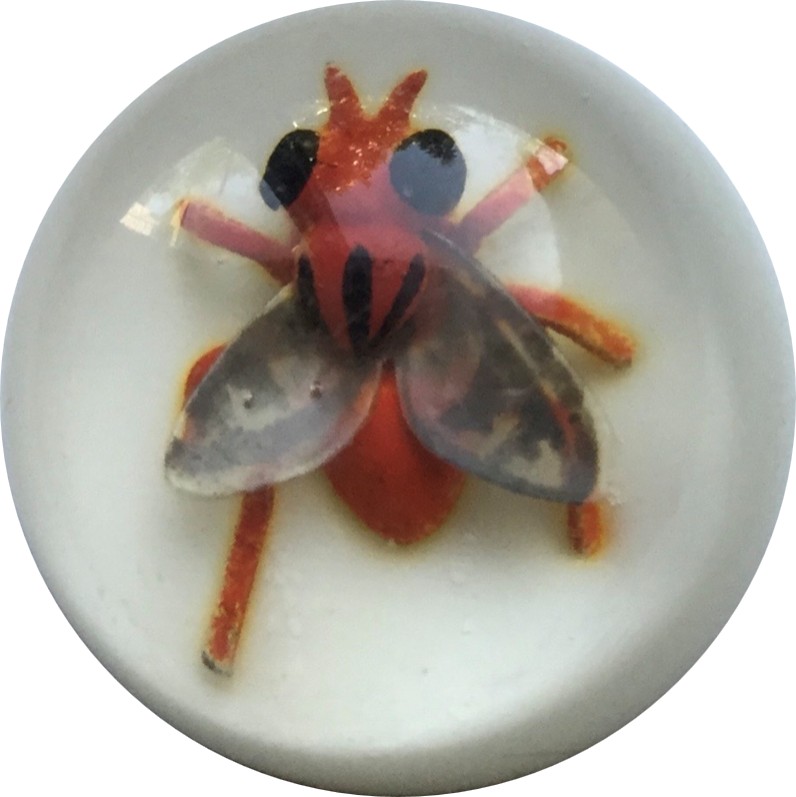
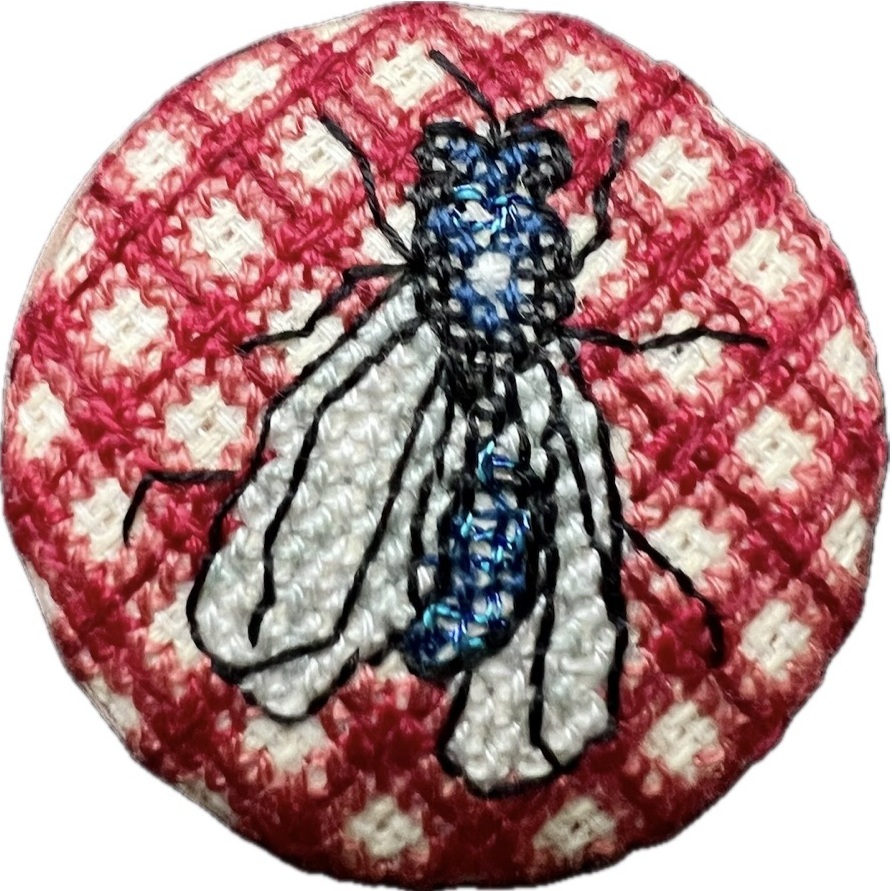
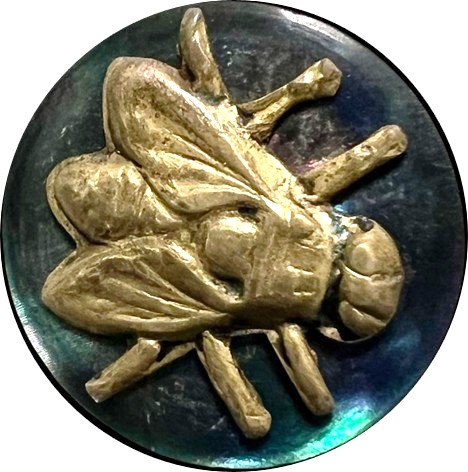
Despite the fact that there is such an abundance of fly species, the ones found on buttons are mainly the common housefly. Most of the renditions show the fly from the top where the segmented body of the fly, the head, the thorax, and the abdomen can be seen. Its two wings are prominent and stretch along the entire length of the body. The fly’s six legs can often be seen. While the lack of movement is evident, and despite the monotony of the view, they really do make an interesting tray. They come in an abundance of materials and are easy to find. There are many different artistic finishes, paint, enamel, pastes, etc., and construction techniques used to enhance a button’s appeal.
Flies can carry typhoid, anthrax, and cholera. Mosquitoes can carry malaria, encephalitis, dengue fever, and West Nile. This is one reason why flies are generally associated with death and decay. Another reason is, in our cycle of life, they are decomposers which feed on dead and decaying animals and trash. Most species, however, don’t cause harm to humans and, in fact, play an important role in the life cycle. One of the most important functions they perform is transferring pollen from one plant to another. They are second only to bees in this function. Flies eat a number of insects and have been specifically used to control other species which cause harm to crops. Flies themselves are a food source for many animals such as frogs, birds, and lizards. Baby larvae, maggots, have been used by doctors to help patients with flesh wounds, especially burn victims as they eat away the damaged flesh which helps the wound heal.
In Prometheus Bound, by Aeschylus, Hera, wife of the god Zeus, sends a gadfly to torment Zeus’ mistress, Io, who he turned into a cow to hide her from Hera. In the play Anthony and Cleopatra, by William Shakespeare, he alludes to this myth as he writes that Cleopatra’s quick departure from the Actium battlefield is like a “cow being chased by a gadfly”.
Also in mythology, Zeus sent a fly to bite the horse Pegasus which caused him to throw off Bellerophon as he attempted to ride Pegasus to Mount Olympus. Instead, he fell to earth.
The nursery rhyme, “There was an Old Woman (Who Swallowed a Fly)” tells the story of an old woman who swallowed a variety of creatures in an attempt to rid herself of the fly she first swallowed.
This article may not be reproduced in any form, print or digital, without express written permission from the author, Deborah Allnutt. Copyright 2026

AN AFTER SHOW AH-HA MOMENT
Taking Another Look at my Buttons
Sometime a few years back, I stopped competing in any competitions. No particular reason why, just stopped. I had my share of blue, red, and green ribbons, but they weren’t incentive even when I competed and suddenly, they seemed much less so. Then just as suddenly, it seemed time to start competing again. My state’s spring show what on the horizon and I had written and submitted two awards. The first was an award for moonglows. The second was shapes, specialized to anything but round, i.e., hearts, spindles, rectangles, squares, etc. It was after this competition that I began to look at my buttons differently.
During this competition hiatus I still purchased buttons. Buttons bring me joy and there’s never been one purchased just because it fits some criteria to complete a tray. My focus was on purchasing as many materials as possible for a subject and anything that came along with it was just a happy bonus. Over the years I thought if competition were to happen again, having a variety of materials would be halfway to a completed tray. That idea was way off base.
The first award I entered, moonglows, was straightforward and came together with little effort. The second award, shapes, anything but round, was fun to put together, but I knew going in it wasn’t a winner but couldn’t put my finger on why. When I saw the first and second place trays, all became clear, and the judges even wrote in on the tray slip and confirmed it; their buttons had more techniques. We all had 25 different materials, but theirs were just better. Their trays included pipestone, leather, shell, and casein, materials I rarely consider. Their trays were vibrant, showcasing pastes, cut steels, and more. Mine was flat and basic. The first lesson I learned from this competition was to get out of my comfort zone, to look beyond the obvious, and explore and learn about more materials.
Gay 90’s are a favorite of mine. Over the years as I’ve collected one here and there, I have paid attention to things like the shape and color of the stones, the settings, and giving a cursory thought to embellishments. It wasn’t until after this show and the judge’s comment on my third place tray that I really too a hard look at what I had. Then I not only saw a beautiful button in front of me, but one that had several things going for it. First, it’s an oval shape. Second, it’s set in copper. Third, it has tow tear shaped amethyst stones divided by five clear pastes set on an angle. Look at that beautiful leaf border.
I took this approach to some of my other buttons and was really surprised at what I had, what I had missed. The nuances and beauty of these buttons opened up. For example, this large celluloid has an imitation tortoise shell background, an all over (diaper) pattern, and a horn center. Lovely. This small design under glass spider has three materials, brass and leather sitting atop either horn or composition.
But this article isn’t really about competition. It’s an encouragement to all of us to learn about what we have. It’s about stretching ourselves to discover and study a variety of materials, a button’s origins, its construction. It’s about learning the difference between Bakelite and casein. It’s about knowing whether something been inlaid or inset. WBA does not hold competitions nor does it advise on trays. What WBA does do is try to help you understand what you hold in your hand. We study materials, techniques, button artists, a button’s age, back marks, and anything else to help us understand our tiny treasures. Worksheets can be found on our website that will guide you and help you learn about a variety of materials and subjects.
The wonderful thing about button collecting is that there is always something new to discover. Recently WBA hosted a program by Alan Hepburn on West’s Patent Solitaires. After nearly 30 years of button collecting these remained unknown to me until now. Perhaps it will be the beginning of a new hunt for me and maybe some other collectors who were previously unaware of these buttons, but totally mesmerized by them.
You don’t have to have competition ready trays on your walls. You just need to love what you have. You need to know what you have. Learning about your buttons and sharing that information with your club and others is an important part of collecting, something we strive for here at WBA. We become a much smarter and stronger when we are all involved in our education.
*Alan Hepburn has written four articles about West’s Patent Solitaires and which can be found on the website. The video taped program will be available for viewing at a later date.