

by Jocelyn Howells
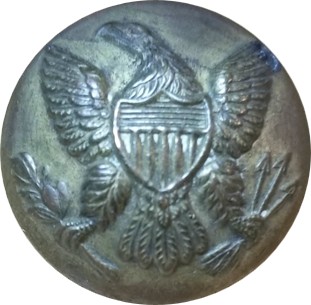
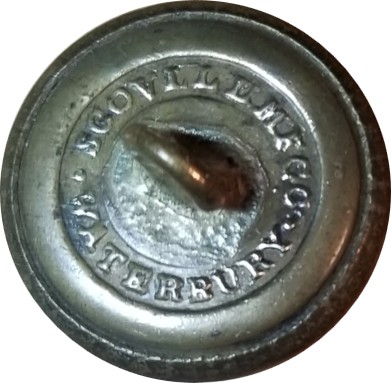
This button is a Civil War general service coat button, often referred to as a Union eagle button, which dates from 1861-1865 and was worn by U.S. Army enlisted men and non-commissioned officers.
It is a domed, stamped brass button featuring a spread American eagle holding an olive branch in its right talons and three arrows in its left talons, with a shield across its chest – a very common motif.
It was produced by Scovill Manufacturing Company of Waterbury, Connecticut. The back mark, as shown here, is a RMDC style mark (raised mark in depressed channel), which we associate with buttons of this era. The maker’s name and branding elements were stamped as raised lettering inside a sunken groove on the back of the button.
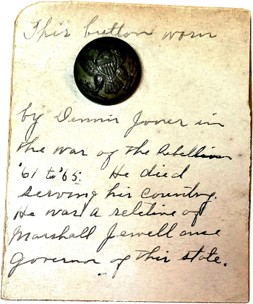
This would be considered a common Civil War button – however, its story is anything but common. We know much about the soldier who died wearing this button. His name was Dennis Jones, as it says on the note that was attached to the button when I acquired it in a collection years ago.
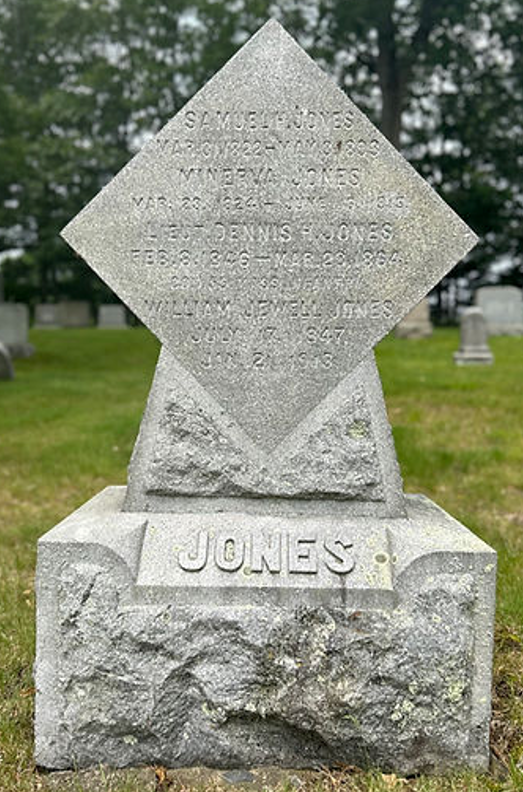
Dennis Hartwell Jones was the oldest of six children born to Samuel H. and Minerva (Jewell) Jones, born in Winchester NH on February 8, 1846. His father was a piano maker, and they moved to Brattleboro VT and then to Boston MA where Samuel had found work. The family made their home in the West Roxbury neighborhood. Living with them in 1860 was musician George Graves, who would later form the Boston Musical Instrument Company.
Aged only 17, Dennis (with his parents’ blessing) joined the 44th Massachusetts Regiment as a Private on September 12, 1862. Private Jones served in Companies H and K. He gave his occupation as a mechanic. On June 16, 1863 he transferred to the newly formed 55th Massachusetts Regiment, and was promoted to 1st Lieutenant of Company I. The 55th Massachusetts was the second of Massachusetts’ African American regiments, created because the 54th Massachusetts had many more recruits than it could accommodate. All of the officers were white.
Lt. Jones was in command of Company I for its first few weeks while the Company Captain was recovering from an illness. Though he was only 17 he proved himself a capable, personable, and quiet leader.
Lt. Jones was accidentally shot in the heart by friendly fire at Yellow Bluff FL on March 23, 1864. While scouting he and his party came across an unexpected foraging party of New York Engineers and, in the confusion, one of the men accidentally discharged his pistol and shot Lt. Jones. His mother applied for and was granted the pension for her son’s service.
From The Medical and Surgical History of the War of the Rebellion. Part I, Volume II: Surgical History by U. S. Army Surgeon General’s Office, 1883:
Chapter II. Gunshot Wounds of the Chest.
Lieutenant Dennis H. Jones, Co. I, 55th Massachusetts Volunteers, was accidentally shot through the heart by a fellow-officer at Yellow Bluff, Florida, March 23d, 1864, while they were attempting to escape from an apprehended attack by the rebels.
In the band of the latter officer was a Smith and Wesson revolver cocked, which was discharged as they both slipped and fell together at the edge of the water into which they were trying to drag their boat. Jones instantly fell back into the water, only exclaiming twice “save me! save me! ” evidently under the impression that the shot came from the enemy; his face also expressing rather terror at the report than bodily pain from the wound. For an instant he convulsively grasped the rope, but soon let go, and with one gurgling respiration both heart and lungs appeared to have ceased to act within half a minute.
The supposed rebels proving to be a party of engineer soldiers from this post, the non-recognition having been mutual, the body was recovered and brought to the post hospital; no further sign of life was manifested, except a sort of groan when the body was raised, about five minutes after the accident, which may well be supposed to have been the result of the sudden displacement of the large quantity of fluid in the cavities rather than of any conscious voluntary action.
The accident occurred at five o’clock P. M.
… a history of the case, by Assistant Surgeon Burt G. Wilder, 55th Massachusetts Volunteers
As the handwritten note with the button says, “Dennis was a relative of Marshall Jewell, once governor of this state.”
Marshall Jewell (20 October 1825-10 February 1883) was born in Winchester NH, trained as a currier in Woburn MA, and worked as a telegrapher in Columbia TN where he became a Whig. In 1849 he became supervisor of the Boston-New York City telegraph line in New York. The next year he moved to Hartford CT to become a partner in his father’s tanning business. Their business flourished during the American Civil War due to contracts with the Union Army.
Indeed, Marshall Jewell was the Republican Governor of Connecticut from May 1869 to May 1870, and from May 1871 to May 1873. He then served as President Ulysses S. Grant’s Ambassador to Russia from 1873 to 1874, and as the US Postmaster General from August 1874 to July 1876. Jewell’s support for reforming the Post Office and running it as a business rather than through patronage alienated him from Grant, who fired him. Jewell ran for US President unsuccessfully in 1876, and died in 1883.
RESOURCES
https://www.graveyardauntie.com/post/dennis-h-jones
https://historica.fandom.com/wiki/Marshall_Jewell
The Medical and Surgical History of the War of the Rebellion. Part I, Volume II: Surgical History by U. S. Army Surgeon General’s Office, 1883:
This article may not be reproduced in any form, print or digital, without express written permission from the author, Jocelyn Howells. Copyright 2026
