

This article may not be reproduced in any form, print or digital, without express written permission from the author, Deborah Allnutt. Copyright 2026.
by Debbie Allnutt 2026
For centuries, the plays of William Shakespeare have played out on stages of grandeur, local venues, and school stages. Learning his language has been the bane of many a high school student struggling through Hamlet or A Midsummer Night’s Dream.
Button makers of the 18th and 19th centuries discovered that the dramatic scenes and relatable characters were good subjects for buttons. What makes these buttons especially delightful is the scale. Shakespeare’s sweeping stories—kings, ghosts, fairies, lovers, and villains are condensed into objects small enough to fit in the palm of a hand. Each button becomes a tiny stage with its characters frozen mid-performance.
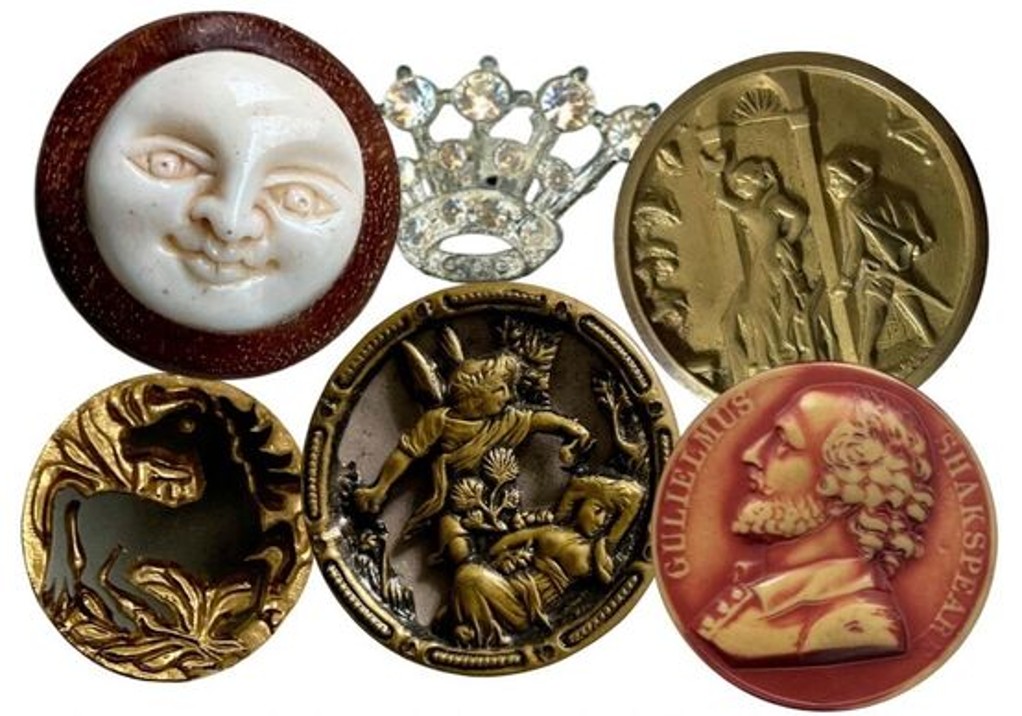
Shakespeare wrote 37 plays, so there is much from which to gain inspiration. The earliest of his plays, Henry VI, parts I, II, and III, were written around 1591-1592. His final plays were written between 1612 and 1613. Astonishing, isn’t it, that something written so long ago is still vibrant and popular today.
A tray full of examples from his prose and characters would make a lovely tray indeed.
From Romeo and Juliet: Act II, Sc. 2
Juliet: O, swear not by the moon, the inconsistent moon,
That monthly changes in her circled orb,
Lest that thy love prove likewise variable.
From Richard III: Act V, Sc. 2
King Richard: A horse! A horse! My kingdom for a horse!
From Henry VI Part I: Act IV, Sc. 1
Gloucester: Lord Bishop, set the crown upon his head.
Winchester: God save King Henry, of that name the sixth!
Besides the unforgettable line, many characters shine, including Macbeth, Lady Macbeth, Oberon, and Titania. The world of Shakespeare isn’t limited to living only on the stage and in books. Sometimes it lives on a button. Aren’t buttons fascinating?
If you’ve created a tray illustrating Shakespeare’s work or any other written works, won’t you share it with us? Email me a picture.
This article may not be reproduced in any form, print or digital, without express written permission from the author, Deborah Allnutt. Copyright 2026
